はじめに
「クラス設計はできるけど、コードが複雑になるとどこかで壊れる…」
そんな経験はありませんか?
オブジェクト指向プログラミング(OOP)は強力ですが、可変状態と副作用が絡み合うと、デバッグが困難なスパゲッティコードに陥りがちです。一方、関数型プログラミング(FP)は純粋で美しいですが、実務のI/O処理やDB操作との折り合いが難しい。
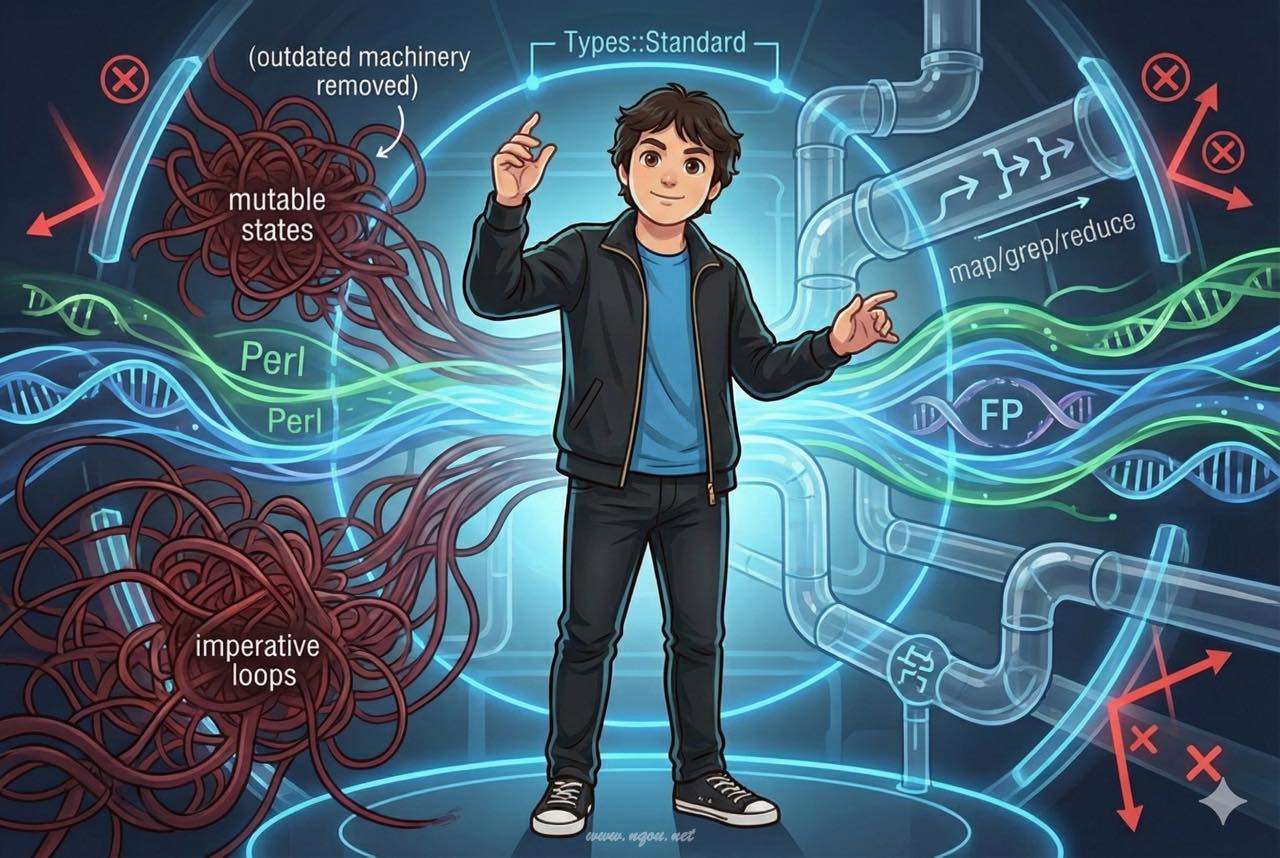
この記事では、OOPとFPの「いいとこ取り」をした「ハイブリッド設計」を学びます。
ECサイトの注文処理システムを題材に、「動く → 破綻 → パターン導入 → 完成」というストーリーで、段階的にコードを改善していきます。
この記事で学べること
| 章 | テーマ | 学べること |
|---|
| 1 | 可変状態の問題 | なぜMutableなオブジェクトは壊れやすいか |
| 2 | イミュータビリティ | Mooのis => 'ro'とwith_*パターン |
| 3 | 純粋関数 | 副作用を分離してテスタビリティを向上 |
| 4 | 高階関数 | map/grep/reduceで宣言的に書く |
| 5 | FCISパターン | Functional Core, Imperative Shell |
| 6 | 型制約 | Types::Standardで実行時エラーを防ぐ |
| 7 | テスト戦略 | FCISパターンでテストが書きやすくなる理由 |
| 8 | 完成形 | ハイブリッド設計の全体像 |
対象読者
- OOPの基本(クラス、継承、カプセル化)は理解している
- 複雑な状態管理やスパゲッティコードに悩んでいる
- Perlで実務的なコードを書いている
技術スタック
- Perl v5.36以降(シグネチャ、
say、postfix dereferenceなど) - Moo(軽量OOPフレームワーク)
- Types::Standard(型制約)
- List::Util(高階関数)
第1章:動いているコードが壊れる夜 - 可変状態の問題

今回の目標
- 可変状態(Mutable State)がどのようにバグを引き起こすか理解する
- 「同じオブジェクトを複数箇所で変更する」危険性を体感する
動く:ECサイトの注文クラス
まずは素朴な注文クラスを作ってみましょう。
 1
 2
 3
 4
 5
 6
 7
 8
 9
10
11
12
13
14
15
16
17
18
19
20
21
22
23
24
25
26
27
28
29
30
| package Order;
use v5.36;
use Moo;
has customer_name => (is => 'rw', required => 1);
has items => (is => 'rw', default => sub { [] });
has discount_rate => (is => 'rw', default => 0);
has total => (is => 'rw', default => 0);
sub add_item ($self, $item) {
push $self->items->@*, $item;
$self->_recalculate_total();
}
sub apply_discount ($self, $rate) {
$self->discount_rate($rate);
$self->_recalculate_total();
say "割引 $rate% を適用しました"; # 副作用!
}
sub _recalculate_total ($self) {
my $subtotal = 0;
for my $item ($self->items->@*) {
$subtotal += $item->{price} * $item->{quantity};
}
my $discount = $subtotal * ($self->discount_rate / 100);
$self->total($subtotal - $discount);
}
1;
|
一見問題なさそうですが…
破綻:予期せぬバグ
このコードには複数の問題が潜んでいます。
 1
 2
 3
 4
 5
 6
 7
 8
 9
10
11
12
13
14
15
16
17
18
19
| my $order = Order->new(customer_name => 'Alice');
$order->add_item({ name => 'Book', price => 1000, quantity => 2 });
say "注文合計: " . $order->total; # 2000
# クーポン処理
my $coupon_handler = sub ($o) {
$o->apply_discount(10); # 10%割引
};
# 会員割引処理
my $member_handler = sub ($o) {
$o->apply_discount(20); # 20%割引(クーポンを上書き!)
};
$coupon_handler->($order);
say "クーポン後: " . $order->total; # 1800
$member_handler->($order);
say "会員割引後: " . $order->total; # 1600
|
問題: クーポン10%と会員割引20%で合計30%引きを期待していたのに、割引が上書きされて20%しか適用されていません。
これが可変状態の罠です。
問題の本質
- 予測不能: 同じオブジェクトを複数箇所で変更すると、状態がどうなるか予測困難
- 追跡困難: どこでいつ状態が変わったかデバッグしにくい
- テスト困難: テスト前後で状態が変わるため、独立したテストが書きにくい
今回のポイント
is => 'rw'(Read-Write)は便利だが危険- 「誰でも変更できる」は「誰もが壊せる」
- 次章で、この問題をイミュータビリティで解決します
第2章:時を戻そう - イミュータビリティの魔法
前章の振り返り
可変状態は、複数箇所からの変更により予期せぬバグを引き起こしました。
今回の目標
- イミュータブル(不変)オブジェクトの概念を理解する
- Mooの
is => 'ro'とwith_*パターンを習得する
完成:イミュータブルな注文クラス
 1
 2
 3
 4
 5
 6
 7
 8
 9
10
11
12
13
14
15
16
17
18
19
20
21
22
23
24
25
26
27
28
29
30
31
32
33
34
35
36
37
38
39
40
41
| package Order::Immutable;
use v5.36;
use Moo;
has customer_name => (is => 'ro', required => 1); # 読み取り専用!
has items => (is => 'ro', default => sub { [] });
has discount_rate => (is => 'ro', default => 0);
# 合計は毎回計算(導出値)
sub total ($self) {
my $subtotal = 0;
for my $item ($self->items->@*) {
$subtotal += $item->{price} * $item->{quantity};
}
return $subtotal * (1 - $self->discount_rate / 100);
}
# with_* パターン: 新しいオブジェクトを返す
sub with_item ($self, $item) {
my @new_items = ($self->items->@*, $item);
return Order::Immutable->new(
customer_name => $self->customer_name,
items => \@new_items,
discount_rate => $self->discount_rate,
);
}
sub with_discount ($self, $rate) {
return Order::Immutable->new(
customer_name => $self->customer_name,
items => $self->items,
discount_rate => $rate,
);
}
sub with_additional_discount ($self, $rate) {
my $new_rate = $self->discount_rate + $rate;
return $self->with_discount($new_rate);
}
1;
|
安全な処理フロー
 1
 2
 3
 4
 5
 6
 7
 8
 9
10
11
12
13
14
15
16
17
18
19
20
21
| my $order = Order::Immutable->new(customer_name => 'Alice')
->with_item({ name => 'Book', price => 1000, quantity => 2 });
say "注文合計: " . $order->total; # 2000
my $apply_coupon = sub ($o) {
return $o->with_additional_discount(10); # 新しいオブジェクトを返す
};
my $apply_member = sub ($o) {
return $o->with_additional_discount(20);
};
my $order_coupon = $apply_coupon->($order);
say "クーポン後: " . $order_coupon->total; # 1800
my $order_both = $apply_member->($order_coupon);
say "両方適用後: " . $order_both->total; # 1400 (30%引き!)
# 元のオブジェクトは変わっていない
say "元の注文: " . $order->total; # 2000
|
ポイント: 各関数は新しいオブジェクトを返すので、割引が正しく合算されます。
イミュータブル更新フロー
	graph LR
    A[元のOrder] -->|with_additional_discount 10%| B[新しいOrder]
    B -->|with_additional_discount 20%| C[最終Order]
    A -.元のOrderは不変.-> A
    B -.途中のOrderも不変.-> B
今回のポイント
is => 'ro'でフィールドを読み取り専用にする- 変更が必要な場合は
with_*メソッドで新しいオブジェクトを返す - 元のオブジェクトは常に不変 → 安全
第3章:副作用という名の地雷 - 純粋関数で守る
前章の振り返り
イミュータビリティにより、状態の予期せぬ変更を防げるようになりました。
今回の目標
- 純粋関数と副作用の違いを理解する
- 副作用を分離してテスタビリティを向上させる
動く:副作用が混在したコード
 1
 2
 3
 4
 5
 6
 7
 8
 9
10
11
12
| sub calculate_subtotal_impure ($items, $db, $logger) {
$logger->info("計算開始: " . scalar(@$items) . "件"); # 副作用
my $subtotal = 0;
for my $item (@$items) {
$subtotal += $item->{price} * $item->{quantity};
$db->update_stock($item->{id}, $item->{quantity}); # 副作用
}
$logger->info("計算完了: $subtotal"); # 副作用
return $subtotal;
}
|
問題: ログ出力、DB更新が計算ロジックと混在しており、テストが困難。
破綻:テストが書けない
1
2
| # このテストを書くには、$db と $logger のモックが必要
# さらに、実行するたびにDBが更新される副作用がある
|
完成:純粋関数として抽出
 1
 2
 3
 4
 5
 6
 7
 8
 9
10
11
12
13
14
15
16
| # 純粋関数: 入力だけで出力が決まる、副作用なし
sub calculate_subtotal_pure ($items) {
my $subtotal = 0;
for my $item (@$items) {
$subtotal += $item->{price} * $item->{quantity};
}
return $subtotal;
}
sub calculate_discount_pure ($subtotal, $discount_rate) {
return $subtotal * ($discount_rate / 100);
}
sub calculate_total_pure ($subtotal, $discount) {
return $subtotal - $discount;
}
|
テストが簡単に
 1
 2
 3
 4
 5
 6
 7
 8
 9
10
11
| use Test::More;
is(calculate_subtotal_pure([
{ price => 1000, quantity => 2 },
{ price => 500, quantity => 3 },
]), 3500, '小計計算');
is(calculate_discount_pure(10000, 10), 1000, '10%割引');
is(calculate_total_pure(10000, 1000), 9000, '合計計算');
done_testing;
|
ポイント: モック不要、外部依存なし、高速実行。
純粋関数の特徴
| 特徴 | 純粋関数 | 不純な関数 |
|---|
| 同じ入力 | 常に同じ出力 | 出力が変わる可能性 |
| 副作用 | なし | あり(ログ、DB、ファイル等) |
| テスト | 簡単 | モックが必要 |
| 実行順序 | 関係なし | 依存する場合あり |
今回のポイント
- 純粋関数 = 入力だけで出力が決まる、副作用なし
- 計算ロジックを純粋関数として抽出する
- 副作用(ログ、DB)は呼び出し側に押し出す
第4章:ループ地獄からの脱出 - 高階関数という武器
前章の振り返り
純粋関数により、テストしやすいコードになりました。
今回の目標
- 命令的なloopを宣言的なコードに書き換える
- map/grep/reduceの使い方を習得する
動く:命令的なループ
 1
 2
 3
 4
 5
 6
 7
 8
 9
10
11
12
13
14
15
16
17
18
19
20
21
22
23
24
| sub process_items_imperative ($orders) {
my @result;
for my $order (@$orders) {
for my $item ($order->{items}->@*) {
if ($item->{in_stock}) {
for my $i (1 .. $item->{quantity}) {
push @result, {
order_id => $order->{id},
item_name => $item->{name},
unit_price => $item->{price},
};
}
}
}
}
my $total = 0;
for my $r (@result) {
$total += $r->{unit_price};
}
return { items => \@result, total => $total };
}
|
問題: 3重ネストのループは読みづらく、バグが入りやすい。
完成:宣言的なパイプライン
 1
 2
 3
 4
 5
 6
 7
 8
 9
10
11
12
13
14
| use List::Util qw(reduce);
sub filter_available_items ($items) {
return [ grep { $_->{in_stock} } @$items ];
}
sub calculate_totals_by_category ($items) {
return reduce {
my $cat = $b->{category} // 'other';
$a->{$cat} //= 0;
$a->{$cat} += $b->{price} * $b->{quantity};
$a;
} {}, @$items;
}
|
高階関数の使い分け
| 関数 | 用途 | 例 |
|---|
map | 変換 | 価格を税込みに変換 |
grep | フィルタ | 在庫ありだけ抽出 |
reduce | 集約 | 合計金額を計算 |
今回のポイント
grep: 条件に合う要素を抽出map: 各要素を変換reduce: 畳み込み(集約)- 宣言的コードは「何をするか」を記述、命令的コードは「どうやるか」を記述
第5章:コアとシェルを分ける - FCISパターン

前章の振り返り
高階関数により、宣言的で読みやすいコードになりました。
今回の目標
- Functional Core, Imperative Shell(FCIS)パターンを理解する
- ビジネスロジックとI/Oを分離する
FCISパターンとは
Functional Core(純粋計算層):
Imperative Shell(副作用層):
- I/O処理(DB、ファイル、ネットワーク)
- 状態管理
- Coreを呼び出して結果を副作用に変換
FCISレイヤー図
	graph TB
    subgraph "Imperative Shell(副作用層)"
        A[OrderService]
        B[DB Repository]
        C[Email Service]
    end
    subgraph "Functional Core(純粋計算層)"
        D[OrderCalculator]
        E[DiscountCalculator]
        F[PriceCalculator]
    end
    A --> D
    A --> B
    A --> C
    D --> E
    D --> F
    style A fill:#ffcccc
    style D fill:#ccffcc
完成:FCIS分離後の設計
Functional Core
 1
 2
 3
 4
 5
 6
 7
 8
 9
10
11
12
13
14
15
16
17
18
19
20
21
22
23
24
25
26
27
28
29
30
31
32
33
34
35
36
37
38
39
40
41
42
43
44
45
46
47
48
| package OrderCalculator;
use v5.36;
sub calculate_discount ($subtotal, $rate) {
return $subtotal * ($rate / 100);
}
sub calculate_tax ($amount, $rate) {
return int($amount * ($rate / 100));
}
sub calculate_shipping ($subtotal, $threshold, $fee) {
return $subtotal >= $threshold ? 0 : $fee;
}
sub calculate_total ($params) {
my $subtotal = $params->{subtotal};
my $discount = calculate_discount($subtotal, $params->{discount_rate} // 0);
my $after_discount = $subtotal - $discount;
my $tax = calculate_tax($after_discount, $params->{tax_rate} // 10);
my $shipping = calculate_shipping(
$subtotal,
$params->{free_shipping_threshold} // 5000,
$params->{shipping_fee} // 500
);
return {
subtotal => $subtotal,
discount => $discount,
after_discount => $after_discount,
tax => $tax,
shipping => $shipping,
total => $after_discount + $tax + $shipping,
};
}
sub validate_order ($order) {
my @errors;
push @errors, 'customer_name is required' unless $order->{customer_name};
push @errors, 'items must not be empty' unless $order->{items} && @{$order->{items}};
return {
is_valid => @errors ? 0 : 1,
errors => \@errors,
};
}
1;
|
Imperative Shell
 1
 2
 3
 4
 5
 6
 7
 8
 9
10
11
12
13
14
15
16
17
18
19
20
21
22
23
24
25
26
27
28
29
30
31
32
33
34
35
36
37
38
| package OrderService;
use v5.36;
use Moo;
has db => (is => 'ro', required => 1);
has mailer => (is => 'ro', required => 1);
has logger => (is => 'ro', required => 1);
sub process_order ($self, $order_data) {
# 1. 検証(Core)
my $validation = OrderCalculator::validate_order($order_data);
unless ($validation->{is_valid}) {
$self->logger->error("Validation failed");
return { success => 0, errors => $validation->{errors} };
}
# 2. 計算(Core)
my $calculation = OrderCalculator::calculate_total({
subtotal => $self->_calc_subtotal($order_data->{items}),
discount_rate => $order_data->{discount_rate} // 0,
});
# 3. 保存(Shell - 副作用)
my $order_id = $self->db->save_order({ %$order_data, %$calculation });
# 4. メール送信(Shell - 副作用)
$self->mailer->send_confirmation($order_data->{customer_email}, {
order_id => $order_id,
total => $calculation->{total},
});
# 5. ログ(Shell - 副作用)
$self->logger->info("Order $order_id processed");
return { success => 1, order_id => $order_id };
}
1;
|
今回のポイント
- Core(内側): 純粋関数、テスト容易、ビジネスロジック
- Shell(外側): 副作用、I/O処理、Coreのラッパー
- 「計算」と「作用」を分離することで、テストしやすく保守しやすい設計に
第6章:型で守る境界線 - Types::Standardの実践
前章の振り返り
FCISパターンにより、ロジックとI/Oを分離できました。
今回の目標
- Types::Standardで型制約を実装する
- 実行時エラーを入口で防ぐ
動く:型制約なしのコード
1
2
3
4
5
6
7
| package OrderItem::NoType;
use v5.36;
use Moo;
has name => (is => 'ro'); # 何でも入る
has price => (is => 'ro'); # 負の値も文字列も入る
has quantity => (is => 'ro'); # 小数も入る
|
問題: 不正な値が渡されても、計算時まで気づかない。
完成:型制約付きクラス
 1
 2
 3
 4
 5
 6
 7
 8
 9
10
11
12
13
14
15
16
17
18
19
20
21
22
23
24
25
26
27
28
| package OrderItem;
use v5.36;
use Moo;
use Types::Standard qw(Str Int Num);
has name => (
is => 'ro',
isa => Str,
required => 1,
);
has price => (
is => 'ro',
isa => Int->where(sub { $_ > 0 }), # 正の整数のみ
required => 1,
);
has quantity => (
is => 'ro',
isa => Int->where(sub { $_ > 0 }), # 正の整数のみ
required => 1,
);
sub total ($self) {
return $self->price * $self->quantity;
}
1;
|
型違反は即座にエラー
1
2
3
4
5
6
7
8
| # これは成功
my $item = OrderItem->new(name => 'Book', price => 1000, quantity => 2);
# これはエラー(負の価格)
eval {
my $bad = OrderItem->new(name => 'Invalid', price => -100, quantity => 1);
};
say "Error: $@" if $@; # 型エラーがキャッチされる
|
型制約フロー図
	graph LR
    A[入力データ] -->|Types::Standard| B{型検証}
    B -->|合格| C[イミュータブルオブジェクト生成]
    B -->|不合格| D[実行時エラー]
    C --> E[安全な処理]
今回のポイント
isa => StrでStringを強制Int->where(sub { $_ > 0 })で正の整数を強制- 型制約により「設計意図」をコードで表現
第7章:テストが書きやすい設計 - FCISの真価
前章の振り返り
型制約により、不正な入力を入口で防げるようになりました。
今回の目標
- FCISパターンがなぜテストしやすいか理解する
- Core(純粋関数)とShell(副作用)のテスト戦略を学ぶ
Coreのテスト:モック不要、高速
 1
 2
 3
 4
 5
 6
 7
 8
 9
10
11
12
13
14
15
16
17
18
19
20
| use Test::More;
# 純粋関数はモック不要でテスト可能
is(OrderCalculator::calculate_discount(10000, 10), 1000, '割引計算');
is(OrderCalculator::calculate_tax(1000, 10), 100, '税金計算');
is(OrderCalculator::calculate_shipping(5000, 5000, 500), 0, '送料無料');
is(OrderCalculator::calculate_shipping(4999, 5000, 500), 500, '送料有料');
subtest 'validate_order' => sub {
my $valid = OrderCalculator::validate_order({
customer_name => 'Alice',
items => [{ name => 'Book', price => 1000, quantity => 1 }],
});
ok($valid->{is_valid}, '有効な注文');
my $invalid = OrderCalculator::validate_order({ items => [] });
ok(!$invalid->{is_valid}, '無効な注文');
};
done_testing;
|
Shellのテスト:最小限のモック
 1
 2
 3
 4
 5
 6
 7
 8
 9
10
11
12
13
14
15
16
| # Shellは薄いレイヤーなので、統合テストも簡単
my $mock_db = MockDB->new;
my $mock_mailer = MockMailer->new;
my $mock_logger = MockLogger->new;
my $service = OrderService->new(
db => $mock_db,
mailer => $mock_mailer,
logger => $mock_logger,
);
my $result = $service->process_order({ ... });
# 副作用の確認
is(scalar(@{$mock_db->saved}), 1, 'DBに1件保存');
is(scalar(@{$mock_mailer->sent}), 1, 'メール1件送信');
|
テスト戦略図
	graph TB
    subgraph "高速・独立した単体テスト"
        A[Core: OrderCalculator]
    end
    subgraph "最小限の統合テスト"
        B[Shell: OrderService]
    end
    A -.純粋関数だからモック不要.-> C[Test::More]
    B -.I/Oは薄いレイヤー.-> D[Mock + Test]
今回のポイント
- Core: 純粋関数なのでモック不要、高速、決定的
- Shell: 薄いレイヤーなので統合テストも簡単
- 「良い設計 = テストしやすい設計」
第8章:ハイブリッド設計の完成形

これまでの振り返り
| 章 | 学んだこと |
|---|
| 1 | 可変状態の危険性 |
| 2 | イミュータビリティで安全に |
| 3 | 純粋関数で副作用を分離 |
| 4 | 高階関数で宣言的に |
| 5 | FCISパターンでアーキテクチャ設計 |
| 6 | 型制約で入口を守る |
| 7 | テスト戦略 |
完成:ECサイト注文処理システム
すべての概念を統合した完成形を見てみましょう。
全体アーキテクチャ図
	graph TB
    subgraph "ユーザー"
        U[Web UI]
    end
    subgraph "Imperative Shell"
        S1[OrderService]
        S2[OrderRepository]
        S3[EmailService]
    end
    subgraph "Functional Core"
        C1[OrderCalculator]
    end
    subgraph "イミュータブルDTO"
        D1[Order]
        D2[OrderItem]
    end
    U --> S1
    S1 --> C1
    S1 --> S2
    S1 --> S3
    S1 -.データ転送.-> D1
    D1 -.構成要素.-> D2
イミュータブルなデータ構造
 1
 2
 3
 4
 5
 6
 7
 8
 9
10
11
12
13
14
15
16
17
18
19
20
| package OrderItem;
use v5.36;
use Moo;
use Types::Standard qw(Str Int);
has name => (is => 'ro', isa => Str, required => 1);
has price => (is => 'ro', isa => Int->where(sub { $_ > 0 }), required => 1);
has quantity => (is => 'ro', isa => Int->where(sub { $_ > 0 }), required => 1);
sub total ($self) { $self->price * $self->quantity }
sub with_quantity ($self, $qty) {
return OrderItem->new(
name => $self->name,
price => $self->price,
quantity => $qty,
);
}
1;
|
 1
 2
 3
 4
 5
 6
 7
 8
 9
10
11
12
13
14
15
16
17
18
19
20
21
22
23
24
25
26
27
28
29
30
31
32
33
34
35
| package Order;
use v5.36;
use Moo;
use Types::Standard qw(Str Num ArrayRef InstanceOf Maybe);
has id => (is => 'ro', isa => Maybe[Str]);
has customer_name => (is => 'ro', isa => Str, required => 1);
has customer_email => (is => 'ro', isa => Str, required => 1);
has items => (is => 'ro', isa => ArrayRef[InstanceOf['OrderItem']], default => sub { [] });
has discount_rate => (is => 'ro', isa => Num->where(sub { $_ >= 0 && $_ <= 100 }), default => 0);
has status => (is => 'ro', isa => Str, default => 'pending');
sub with_item ($self, $item) {
return Order->new(
id => $self->id,
customer_name => $self->customer_name,
customer_email => $self->customer_email,
items => [@{$self->items}, $item],
discount_rate => $self->discount_rate,
status => $self->status,
);
}
sub with_discount ($self, $rate) {
return Order->new(
id => $self->id,
customer_name => $self->customer_name,
customer_email => $self->customer_email,
items => $self->items,
discount_rate => $rate,
status => $self->status,
);
}
1;
|
使用例
 1
 2
 3
 4
 5
 6
 7
 8
 9
10
11
12
13
14
15
16
17
| # イミュータブルなデータ構造で注文を構築
my $order = Order->new(
customer_name => 'Alice',
customer_email => 'alice@example.com',
)->with_item(
OrderItem->new(name => '入門書', price => 3000, quantity => 1)
)->with_item(
OrderItem->new(name => 'ノート', price => 500, quantity => 3)
)->with_discount(10);
# サービスで処理
my $result = $order_service->create_order($order);
if ($result->{success}) {
say "注文ID: " . $result->{order}->id;
say "合計: ¥" . $result->{calculation}->{total};
}
|
ハイブリッド設計の原則まとめ
- イミュータビリティ:
is => 'ro' + with_*パターン - 純粋関数: 副作用のない計算ロジック
- 高階関数: map/grep/reduceで宣言的に
- FCIS: Core(計算)とShell(副作用)の分離
- 型制約: Types::Standardで入口を守る
既存コードへの導入ガイド
- まず純粋関数を抽出: 既存メソッドから計算部分だけを取り出す
- イミュータブル化:
is => 'rw'をis => 'ro'に変更、with_*メソッドを追加 - 型制約を追加: 重要なフィールドからTypes::Standardを導入
- 徐々にFCISへ: 新規コードからFCISパターンを適用
おわりに
「OOPを捨てるな、FPを混ぜろ。」
この記事では、OOPとFPを融合した「ハイブリッド設計」を学びました。
- OOPは「構造」を守る盾
- FPは「計算」を純粋に保つ武器
両者を組み合わせることで、安全で、テストしやすく、保守しやすいコードが書けます。
ぜひ、明日からのコーディングに取り入れてみてください!
参考資料